
Environmental & Climate Impact
Consideration for the planet
We are moving towards future-proofing Eton in how we design, produce, ship, package, and distribute our products. To address the environmental impact of our products, we prioritize material topics such as climate impact, circularity, more sustainable materials, pollution in supply chain, chemical management, and responsible water usage throughout our supply chain.
Our commitment
- Net Zero by 2050 latest.
- 50% reducation of emissions in scope 1-2 by 2030
- 30 % reduction of our scope 3 emissions by 2030
- A fully implemented circular business approach by 2030
- Renewable energy throughout our own operations by 2025
- 100% renewable energy in our supply chain.
- By 2025, all business partners with water intensive operations measure their water use and have set reduction goals.

Science Based Target Initiative
The Science Based Targets initiative (SBTi) has approved Eton Group’s science-based emission reduction targets for its own operations (Scope 1 and 2) as well as its value chain (Scope 3). In addition, the SBTi has validated Eton’s Net Zero targets for Scope 1, 2, and 3. This validation confirms that our climate strategy and targets are scientifically robust and aligned with the Paris Agreement.
The SBTi defines and promotes best practices in science-based target setting, providing a clear framework for organizations to align their emissions reduction strategies with global climate goals. The initiative develops standards, tools, and guidance that enable companies to set greenhouse gas (GHG) reduction targets consistent with limiting global temperature rise and achieving net-zero emissions by 2050 at the latest.
The SBTi is a collaboration between CDP, the United Nations Global Compact, the World Resources Institute (WRI), and the World Wide Fund for Nature (WWF). It operates as a charity, with a subsidiary that independently assesses company targets.
Eton’s near-term targets (validated by SBTi)
- Reduce absolute Scope 1 and 2 GHG emissions by 91.6% by 2030, from a 2019 baseline.
- Reduce absolute Scope 3 GHG emissions by 27.5% by 2030, from a 2019 baseline.
- Eton’s long-term Net Zero targets
- Maintain a minimum 91.6% reduction in Scope 1 and 2 emissions from 2030 through 2050, based on a 2019 baseline.
- Reduce absolute Scope 3 GHG emissions by 90% by 2050, from a 2019 baseline.
These targets demonstrate our commitment to aligning with climate science and contributing to global efforts to limit warming to 1.5°C. The SBTi’s validation marks a milestone in our progress, reinforcing our dedication to accelerating climate action while growing our business profitably and sustainably.


Focus Areas
In our quest to reduce emissions and minimize our impact on ecosystem services, we’re committed to transition from conventional to sustainable materials. We also focus on energy efficiency and on adopting renewable energy sources for Scope 1–3 emissions. Transportation is our third focus area, and we are currently exploring alternatives such as sea and train freight and working on future distribution solutions.
Climate Action
Climate Action is one of our prioritized SDG goals. We are committed to reducing our emissions and minimizing our impact on ecosystem services, and we acknowledge the need to transition from conventional materials and increase the use of preferred materials.
We align with the Paris Agreement, with our emission reduction targets validated by SBTi, and we commit to reach science-based net-zero target by 2050. Eton Group AB commits to maintain at least a 91.6% absolute reduction in Scope 1 and 2 GHG emissions, and to reduce absolute Scope 3 GHG emissions by 90% by 2050, from a 2019 base year. These target boundaries include land-related emissions and removals from bioenergy feedstocks.
Climate Impact
The Science Based Targets initiative (SBTi) has validated Eton’s science-based targets, committing us to reduce Scope 1 and Scope 2 GHG emissions by 46% by 2030 from a 2019 base year, and to measure and reduce Scope 3 emissions. As a long-term target, we have committed to reach net zero by 2050.
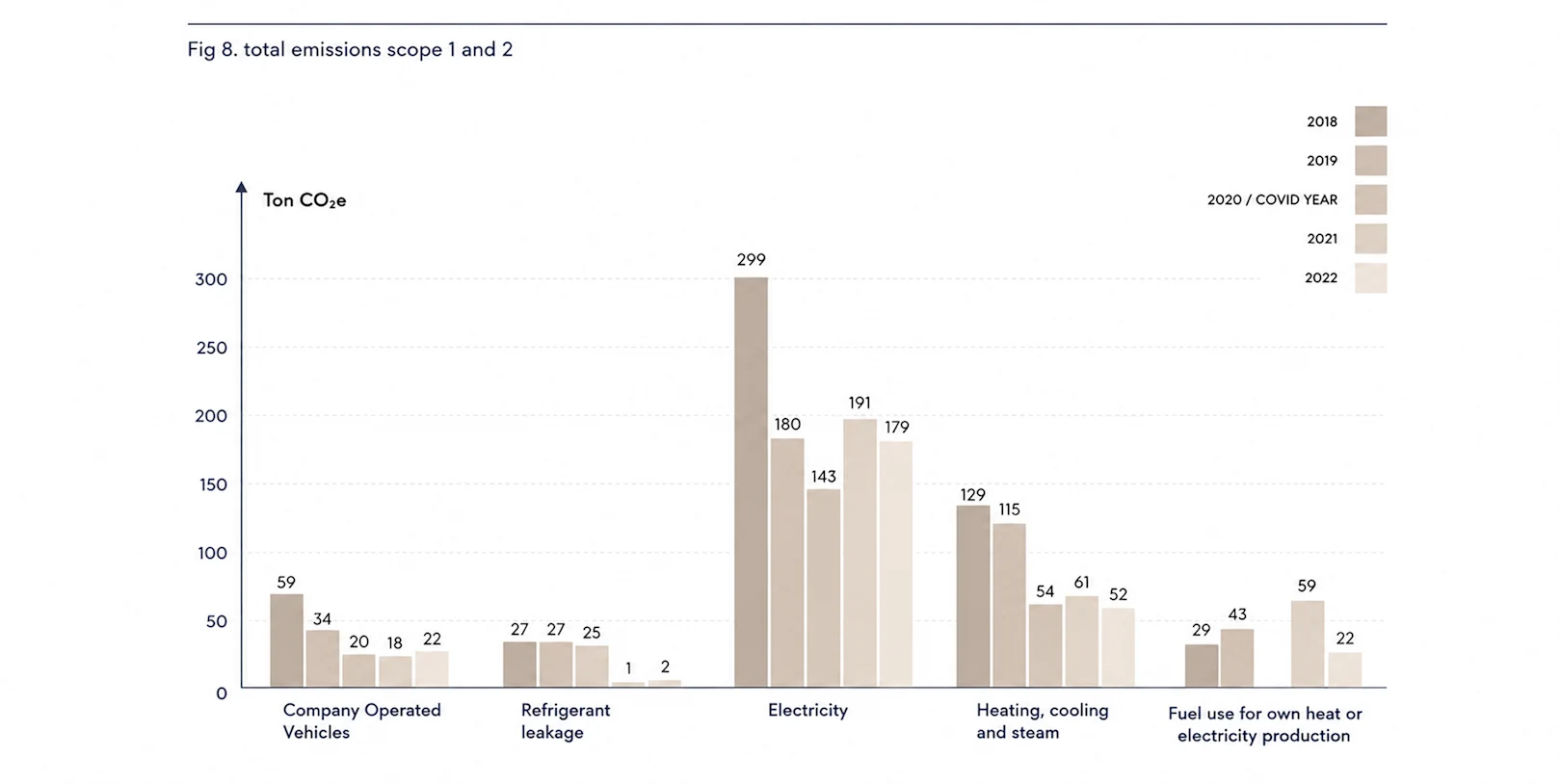
Since 2018, we have been tracking and reporting our Scope 1 and Scope 2 emissions, with 2019 set as the base year. Nearly all of Eton’s emissions, 99.4%, are based on actual data. In the financial year of 2024, our total emissions were 10,242 tons of CO₂e, a 37% reduction compared to 2023.
By consistently measuring, analyzing, and reporting across Scopes 1, 2, and 3, we continue to reduce our climate impact and align our business with science-based targets
Scope 1:
Direct greenhouse emissions that occur from sources that are controlled or owned by an organization.
Scope 2:
Indirect emissions associated with the purchase of electricity, steam, heat or cooling.
Scope 3:
Activities outside our control but within our value chain. We have identified three major areas for emission reduction: our suppliers' energy sources and consumption, our fabric choices, and our distribution.
Materials
Our goal is that all our fabrics will be more sustainable by 2030. We work to combine sustainability with Eton’s quality standards through meticulous sourcing efforts and a focus on materials with lower environmental footprints.
The majority of Eton’s garments are made from cotton. Combined, organic and virgin cotton fibers account for 66% of our total fabric-related emissions—a figure that has decreased thanks to an increased share of organic cotton.
Our assortment team actively works to avoid overstock by sourcing only the necessary amount of fabric and by mapping material choices collection by collection. This strategy reduces excess production and lowers emissions per product. During the year, emissions linked to the amount of purchased fabrics also decreased.
Packaging material
125/1%
Accessories/Ready-made
52/<1%
Transports in
production
292/3%
Tier 1:
Manufacturing
706/7%
Tier 3-4:
Material and yarn
production
5 724/56%
Tier 2:
Textile production
3 259/32%
Emissions scope 3 per category
purchased goods and services
(co2E)
purchased goods and services
(co2E)